
About Tenaci Motorsport

Jonas Borgegård founded Tenaci motorsport in Sweden after years of developing race car drivetrain parts.
What began as a company supplying a few demanding racing drivers with high performance auto parts quickly developed into the “Tenaci” motorsports brand well known among drifting drivers today.


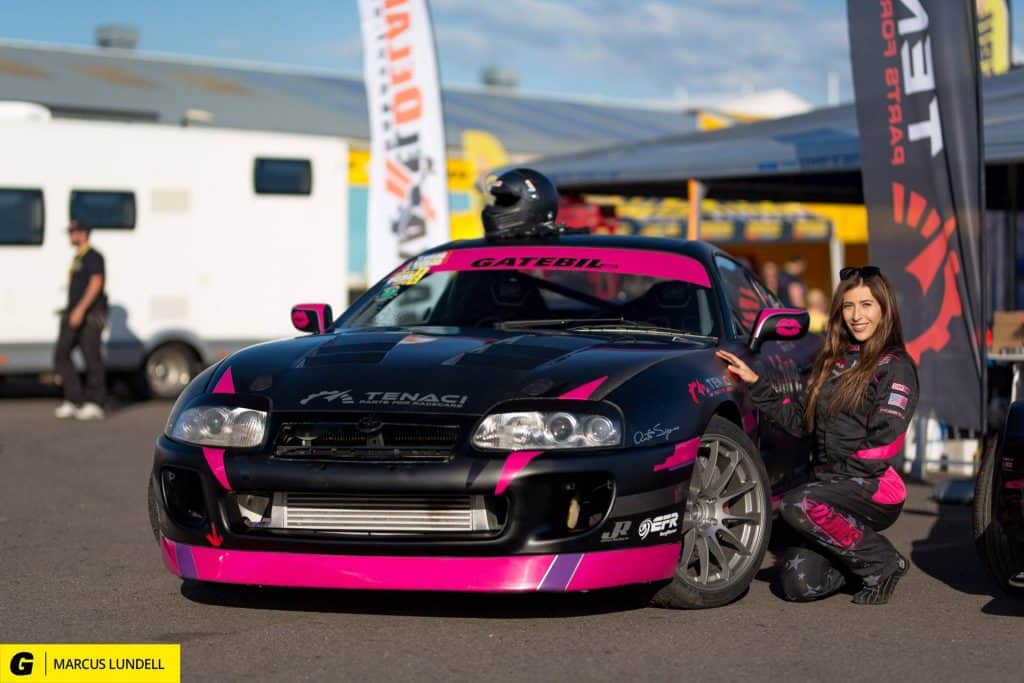
Fredric Aasbø and Hunter Taylor both use Tenaci clutches for competitive drifting
Hunter Taylor a competitive drifting driver from California uses Tenaci 2 disc 240 mm clutch in her Toyota Supra with 800 horsepower
About Tenaci Motorsport
Built on experience. Designed for those who demand more.
Background — Why Tenaci exists
Tenaci Motorsport was founded with one starting point: the conviction that the performance clutch market deserved better. Not better marketing, but better engineering — products that actually hold up when it matters, are honest about what they do and why, and give the driver a genuine advantage rather than just a higher price tag.
The person behind Tenaci is Jonas, who has spent roughly 20 years working closely with the drifting world — not as a spectator, but hands-on, in close contact with the drivers, mechanics and engineers who push cars to their limits on a regular basis. That proximity gave him something that no product catalogue can provide: a detailed understanding of what breaks, what holds, what frustrates a driver at the worst possible moment and what makes the difference between a finished run and a ruined day.
Over those years Jonas also made it a systematic exercise to study clutches from a wide range of manufacturers — disassembling them, analysing the materials, understanding the design choices and observing how they performed under real competition conditions. The goal was never to find a product to copy. The goal was to understand the problem well enough to design a genuinely better solution.
We do not compete on price. We compete on whether the product still works perfectly at the end of a hard season.
Our philosophy — Quality before cost
The performance clutch market contains a wide range of products at a wide range of prices. Some are genuinely good. Many are adequate for light use. A significant number are sold primarily on the basis of a low price point and appealing packaging, and they perform accordingly — which is to say, not particularly well once the conditions become demanding.
At Tenaci we made a deliberate decision early on: we would not enter the race to the bottom. Every component in a Tenaci clutch system is specified because it is the right component for the job, not because it is the cheapest available option that still passes a basic test. That means the price of a Tenaci product is not the lowest on the market. We consider that to be a strength rather than a weakness.
The reasoning is straightforward. A clutch that fails mid-season costs far more than the money saved on a cheaper unit — in replacement parts, in lost competition time, in the damage that a slipping or disintegrating clutch can cause to other drivetrain components. Buying right once is almost always cheaper than buying cheap twice.
The right product from the start is less expensive in the long run than compromising and paying for the consequences later.
The technology — What makes the difference
Tenaci clutch systems are built around four core engineering principles. Each one addresses a specific failure mode or limitation that Jonas observed repeatedly during his years studying the competition and working directly with drivers.
1. Miba sintered friction material
The friction discs in a clutch are where the work actually happens, and the material they are made from determines almost everything about how the clutch performs in practice. After evaluating a large number of friction materials, Tenaci settled on sintered pucks from Miba — one of the most respected names in the field, whose material is also used by established manufacturers including Sachs, Helix, AP Racing and Alcon.
Maximum grip: The sintered material delivers an extremely high friction coefficient, which means the clutch resists slip even during brutal launches, aggressive clutch kicks and sustained high-torque situations. This is not a clutch that needs to be handled with care — it is designed to be used hard.
Thermal stability: Unlike organic friction materials, which can fade significantly as temperatures rise, sintered material maintains its characteristics across a very wide temperature range. In drifting particularly, where a long run can bring the clutch to extreme temperatures, this stability is critical. The clutch that works on the first lap needs to work identically on the tenth.
Durability: Sintered pucks wear more slowly than organic alternatives under hard use, and they wear more predictably. The driver knows what to expect, and can plan maintenance accordingly rather than reacting to sudden degradation.
2. Predictable engagement — the “sweet spot” problem
One of the most persistent criticisms of racing clutches is their driveability — or lack of it. The typical complaint is that a racing clutch is either brutally heavy to operate, or that it engages so abruptly that smooth starts become nearly impossible and precise clutch control in technical driving situations is out of the question.
Tenaci addressed this directly through careful optimisation of the pressure plate geometry and the mechanical leverage of the diaphragm spring system. The result is a clutch that has a defined, findable engagement point — what experienced drivers call a proper “sweet spot” — while still delivering the clamping force that high-torque applications demand.
Controllable engagement: The driver can modulate how the clutch comes in — a smooth, controlled start when the situation calls for it, an aggressive clutch dump when that is what is needed. The clutch responds to what the driver asks of it rather than imposing its own behaviour on the car.
Reduced pedal effort: The mechanical optimisation also means less force is required at the pedal to disengage the clutch. This reduces driver fatigue over a long session, and reduces wear on the release bearing and pedal linkage over the life of the system.
3. The step-down backplate — engineered longevity
As friction material wears, the total stack height of the clutch package decreases. In a conventional clutch system, this translates directly into reduced clamping force — the clutch begins to slip at lower torque levels, performance degrades, and eventually the entire system needs to be replaced.
Tenaci’s step-down backplate solves this problem mechanically. The backplate is designed with multiple adjustment positions — steps — that allow the working height to be restored as the friction material wears. Rotating the backplate to the next step re-establishes the correct geometry and restores original clamping force, effectively resetting the clutch to near-new performance without replacing the major components.
The practical implications are significant. A Tenaci clutch lasts considerably longer before requiring major service. When service is required, the cost is lower because fewer components need to be replaced. And the performance remains consistent throughout the service interval rather than gradually degrading until something finally gives way.
4. Modular design — service, not replacement
Every Tenaci clutch system is designed to be serviced rather than discarded. The pressure plate, backplate, friction discs and intermediate plates are all replaceable individually. If one component wears out or is damaged, that component is replaced — not the entire system.
This modularity also means the system can grow with the car. A driver who starts with a single-disc setup and later increases power significantly does not need a new flywheel or a new clutch cover — they upgrade the components that need to change and keep what is still appropriate. The investment in the Tenaci system continues to pay off as the build evolves.
Designed to be serviced. Built to be upgraded. Not designed to be replaced.
The product range
Tenaci clutch systems are available in three diameter sizes, each available in single, twin or triple-disc configurations depending on the torque requirements and application. The combination of size and disc count allows the system to be precisely matched to the car, the engine and the intended use.
| Size | No. of discs | Character & Recommended use |
| 184 mm | 1, 2 or 3 discs | Very low rotational mass and fast response. Ideal for high-revving naturally aspirated engines and circuit racing where gear change speed is critical. The reduced inertia improves throttle response noticeably. |
| 200 mm | 1, 2 or 3 discs | The most versatile size in the range. Handles very high torque while remaining driveable on the street. The preferred choice for drifting, rally and high-power road cars that also see regular use. |
| 240 mm | 1 or 2 discs | Maximum contact area for the highest torque applications. Suited to heavy vehicles, extreme turbo builds and diesel engines where sheer clamping capacity takes priority over rotational mass. |
The choice between disc counts within a given diameter follows a straightforward logic. More discs means more total friction surface area, which means higher torque capacity — but also more rotating mass and a slightly different pedal feel. For a given power level, the correct configuration is the one that provides adequate torque capacity without adding unnecessary rotational inertia.
Platform support
Tenaci offers bolt-on clutch solutions for a wide range of popular performance platforms. These are not universal kits with adapters and compromises — they are solutions designed specifically for the engine and gearbox combination in question, with the correct flywheel, the correct hub spline count and the correct release bearing specification.
Current supported platforms include:
— Volvo Redblock: B21, B23, B230, B234 and related engines
— Volvo Whiteblock: B5254, B5244 and related five-cylinder engines
— BMW M50, M52, M54, S50, S54: six-cylinder inline engines, cast-iron and aluminium blocks
— BMW M57: six-cylinder diesel, aluminium engine with 310 mm flywheel
— BMW M60, M62: V8 petrol engines
— BMW N54, N55: turbocharged six-cylinder (335i, 135i)
— Toyota 1JZ, 2JZ: inline six-cylinder, the most common drift platform worldwide
— Toyota 1UZ, 2UZ, 3UZ: V8 naturally aspirated and forced induction
— Toyota Supra Mk5 (B58): turbocharged inline six, modern platform
— Mercedes-Benz OM606, OM603: diesel six-cylinder, popular in tuning and motorsport
— Mercedes-Benz M104, M113: petrol six and V8
New platform solutions are developed on an ongoing basis. Where a specific combination is not yet listed, contact Tenaci directly — custom solutions and new applications are part of how the range grows.
Who Tenaci products are for
Tenaci products are used by competition drivers across drifting, rally, rallycross, circuit racing and drag racing. They are also used in high-performance road cars where the driver wants the security of knowing the drivetrain will hold together regardless of how the car is used.
The common thread is not a specific discipline or a specific power level — it is a commitment to using equipment that can be relied upon. A driver who cannot trust their clutch cannot
